
Ritchie County Traffic Court Records
State-law traffic cases in Ritchie County belong to Magistrate Court. Public case information sits in MCRSearch. Paper documents come from Magistrate Clerk Lora Nutt at 304-643-4409. A result typically lists the court location, the citation or case number, the charge, events, the setting, and the disposition. The documents themselves are not online.
A town ordinance ticket follows a different path. Pennsboro's Chapter 15 spells out a municipal-court docket, a report, fines, and records. The town offers no public portal, though. Harrisville, Ellenboro, Cairo, and Pullman post no municipal docket portal either.
State Ticket or Town Ticket?
Where the officer pulled you over does not settle which court holds the case. Read the issuing agency. Check the law or ordinance number, the return address, and the court named on the ticket. Ellenboro's own site notes that the town has no police department. It points to the Ritchie County Sheriff and the West Virginia State Police. A state magistrate case is the likely route there.
In Pennsboro, an ordinance citation belongs with the city recorder and municipal court. For any other town, the Secretary of State municipal directory lists the contacts. An empty MCRSearch result can simply mean the case is municipal.
Looking Up a Traffic Ticket
Turn to MCRSearch when a name or case number is what you have; that is the docket lookup. The Magistrate Court payment search, called MFP, works only with an exact Citation ID, Case ID, or Payment Plan ID. Its own warning says the identifier must match and that MFP is no substitute for a name search.
- Read the ticket for the issuing agency, law, court, and exact identifier.
- Search MCRSearch by case number or name and verify Ritchie County.
- Use MFP only with the exact payment-system ID.
- Call the magistrate clerk or municipality if the citation has not posted.
- Confirm the response date and options before paying or appearing.
Three Traffic IDs Differ
MFP treats these three keys as distinct. The Citation ID is printed on the ticket. The Case ID comes from the court file. A Payment Plan ID exists only after an arrangement is set up. Enter one in the wrong field and MFP returns no match, even for an open case.
- Citation ID
- The exact ticket identifier.
- Case ID
- The identifier assigned to the court case.
- Payment Plan ID
- The key tied to an existing payment plan.
- Disposition
- The court's recorded procedural or final outcome.
Keep the dashes and leading zeros exactly as printed, and call the clerk if an ID is hard to read. The state's official payment search shows all three exact-match routes on one page.
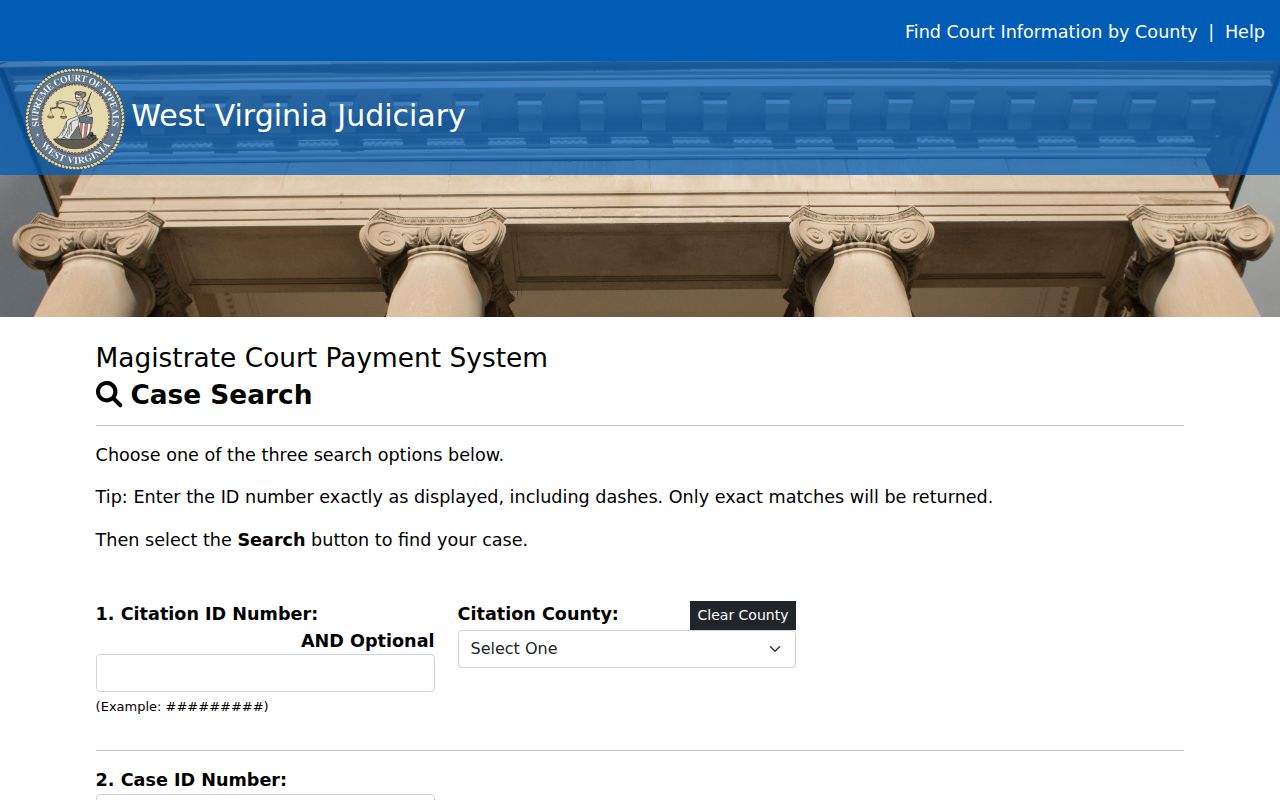
That official page is the lesson: names belong in MCRSearch, never in the payment tool.
How to Find Your Traffic Court Date
Check the response date on the citation against the newest MCRSearch events. A reset or continuance can push the printed date aside. Confirm the time, court, room, and setting type with the magistrate clerk before driving to Harrisville. Address listings flip between North Street and East North Street. Keep Suite 102 handy. Call ahead.
| Citation number | The exact ticket identifier. |
|---|---|
| Court | Ritchie Magistrate Court or the named municipality. |
| Date and time | The current response or appearance setting. |
| Location | The listed courtroom or municipal office. |
| Status | Portal shorthand checked against the latest order. |
If a Ritchie Date Was Missed
Call the court right away. West Virginia law attaches consequences to a failure to respond or appear. These include a warrant in some cases and notice to the Division of Motor Vehicles. Once the DMV learns of a motor-vehicle failure, driving privileges can suffer under section 17B-3-3A. Later payment does not automatically undo each consequence.
Ask the clerk what the docket shows. Ask whether an order or warrant has issued, and what appearance the law now requires. A licensed West Virginia lawyer can explain how the rules apply to you.
Missed response: call the issuing court before using MFP. Payment may act as a plea and may not resolve a warrant or DMV notice.
Pay or Contest a Ticket
Paying is a legal decision, not just a transaction. Under West Virginia Code § 50-5-14A, a fine and costs paid to the court can act as a no-contest plea and judgment. That rule is subject to statutory exceptions. Certain serious categories demand a different response. Among them are specified DUI, reckless-driving, and suspended-driving matters.
To fight the ticket, deal with the court named on the citation. Meet its deadline. The clerk can explain how to enter the plea and get a hearing date. Never send a state case through a municipal payment channel. Do not use MFP for a town ordinance without confirming it works there.
| Paying the Ticket | Contesting the Ticket |
|---|---|
| Can act as a no-contest plea and judgment | Requests a hearing or trial |
| Must follow the court's response deadline | Must use the required method by the deadline |
| MFP, mail, phone, or counter when authorized | The issuing court's stated channel |
Payment has consequences: confirm whether payment records a conviction and whether appearance is required. Ask about any warrant or DMV notice separately.
Ritchie DUI Deferral Records
West Virginia offers a deferral path for qualifying first-offense DUI matters under section 17C-5-2B. The Judiciary's blank form has fields for the county, case, defendant, officer, offense, a signature, the program, and DMV forwarding. A blank form teaches the process. Filled-in copies can hold sensitive data.
Rely on the docket and the clerk to learn whether a motion, order, or disposition is public. Completed driver-license numbers, birth dates, addresses, signatures, test data, and program identifiers should never be republished. Eligibility and deadlines turn on case-specific facts, so ask a lawyer.
The Judiciary's official magistrate forms index keeps the blank traffic-dismissal and DUI-deferral forms apart from actual case records.
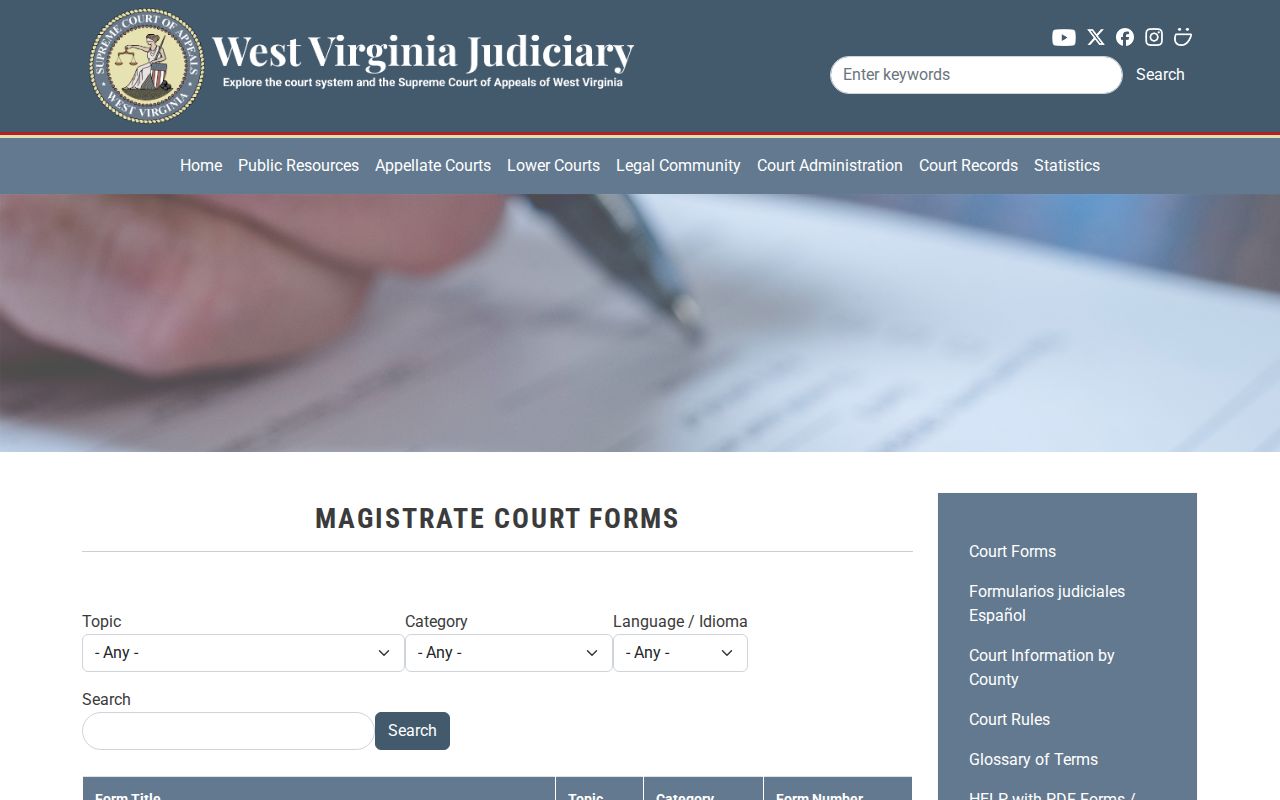
The official forms index draws the line clearly. A blank form explains a process, but a completed filing may contain details the public copy must shield.
Traffic Court Record vs Driving Record
The court record covers the citation case: plea, events, judgment, payment, and disposition. The West Virginia DMV keeps a separate driving record with convictions, points, suspensions, and licensing action. Nothing on the docket proves the DMV side is clean.
| Court Traffic Record | Driver Record | |
|---|---|---|
| Kept by | Magistrate or municipal court | West Virginia DMV |
| Shows | Citation, events, plea, disposition, fines | Reported convictions, points, license status |
| Access | MCRSearch and court clerk | DMV-authorized channel |
Old Ritchie Traffic Cases
Old citations rarely sit in one place. Magistrate retention schedules vary by record type, so an aging Ritchie County ticket may be archived, transferred, expunged, sealed, or simply outside the current display. Search by case number and name first. Then ask the magistrate clerk about the record series. A municipal ticket needs the town's own retention answer.
Give the clerk the year, the issuing agency, the law or ordinance, the citation number, and the document you want. Ask for the docket or disposition. A broad personal-history search is a different request.
Separate schedules govern traffic dismissals, failures to appear, warrants, fine and cost material, DUI matters, misdemeanors, and felonies. So record class matters as much as age. Ask whether a disposition survives when an older working paper does not. A felony that began in Ritchie Magistrate Court may have moved to Circuit Court, where it carries a new case number and its own register of actions. An expunged or sealed matter follows its order and statute, not the normal public search route.
Ritchie Ticket Response Channels
Every citation must state the offense. It must also give a time and place to answer or appear. West Virginia's magistrate criminal-procedure rules allow mail or telephone responses for some citations. Serious matters require an in-person appearance. A not-guilty response may be made in person. Mail works too, but only when the rule allows it. The citation and the court clerk control the right route.
Check MCRSearch for public case information. Then call Lora Nutt's magistrate office at 304-643-4409. Confirm a setting or request a document. The clerk's counter in Suite 102 is the in-person fallback. Mail a response only to an address the court confirms. Official Ritchie listings vary between North Street and East North Street. MFP serves exact-ID payment and status needs. It never replaces a plea, an appearance, or clerk instruction.
A motion to dismiss a traffic citation follows its own service and objection process. Get the current form and filing directions from the official forms index or the clerk. A municipal ordinance ticket goes to the town recorder or municipal court instead. No statewide municipal docket search exists.
Check the issuing agency first. Also compare the statute or ordinance, the return address, and the named court. A state-law ticket written inside a town can still belong in Ritchie Magistrate Court. A Pennsboro ordinance citation may stay with municipal court. Ellenboro has no town police department. It directs residents to county and state law enforcement. So the issuing agency matters most there. Harrisville, Cairo, and Pullman offer no public municipal case portal either.
Copies and Fees
MCRSearch is free for case information. It does not provide documents. Magistrate rules set ordinary copies at 25 cents per page. Fax service costs $2 for the first page and $1 for each later page. MFP includes a $2 online-payment context, which is not a copy fee. Confirm current charges with the clerk.
Name the exact item you need. That may be a docket sheet, disposition, order, payment receipt, or certified court record. A free screen result is not a certified copy. Before mailing a request, confirm the page count, delivery charge, payment method, and whether the magistrate clerk can send the record electronically. A town ticket may follow different copy and payment practices, so the municipality must quote its own terms.
Keep payment and copy charges distinct. The MFP service charge applies to an online payment. The magistrate copy rule covers pages the clerk produces. Certification can also change the request. Describe the intended document and ask for a quote before paying. Keep the receipt and the court disposition separate, because each proves a different step in the Ritchie County traffic case.
| Item | Fee | Notes |
|---|---|---|
| Magistrate ordinary copy | 25 cents per page | Ask for the exact item |
| Fax delivery | $2 first page; $1 each later page | Confirm availability |
| Certified copy | Clerk quote | State the official use |