
Searching Ritchie County Criminal Dockets
The West Virginia Judiciary court-record gateway is the starting point. It keeps circuit records separate from magistrate records. For magistrate criminal and traffic matters, the free Magistrate Case Record Search accepts a name or case number. It is also known as MCRSearch. Circuit criminal cases run through the registered West Virginia Public Access Search System, known as WVPASS. Neither route gives a complete statewide criminal-history check.
Have the details ready first. That means the full name, a rough filing year, Ritchie County as the location, and any case or citation number. Similar names demand care. A felony can open with a magistrate complaint and later continue in Circuit Court, so a single case may leave entries in two systems. If the online result is unclear, the current Ritchie County court directory names the clerk to call.
- Choose MCRSearch for a magistrate matter or WVPASS for a circuit matter.
- Search the exact case number when available; otherwise use the most complete name.
- Match Ritchie County, case location, filing date, and charge before opening the detail.
- Read events in date order and distinguish a hearing setting from a final disposition.
- Request a plain or certified document from the magistrate or circuit clerk when proof is needed.
Ritchie MCRSearch Result Limits
MCRSearch shows public case information. It does not serve scanned pleadings, certified judgments, or other filed papers. The Judiciary caps each search at 30 records. A broad surname query can hide a match beyond that limit. Narrow the request. Add a first name or case number, check the case location, and call the Ritchie Magistrate Clerk if the result set stays too large.
A result can show the court and case number. Parties, charge or complaint data, events, settings, and disposition information may also appear. Warrant, service, bond, rights-sheet, and reporting codes may appear too. Labels describe the system. They do not promise a downloadable complaint, order, or rights sheet. Copies come from the clerk. Lora Nutt, Ritchie County Magistrate Court Clerk, serves Suite 102 at the county judicial complex and answers 304-643-4409.
The official MCRSearch entry screen presents the captcha, the terms, and the public-use warning. The search starts after that.
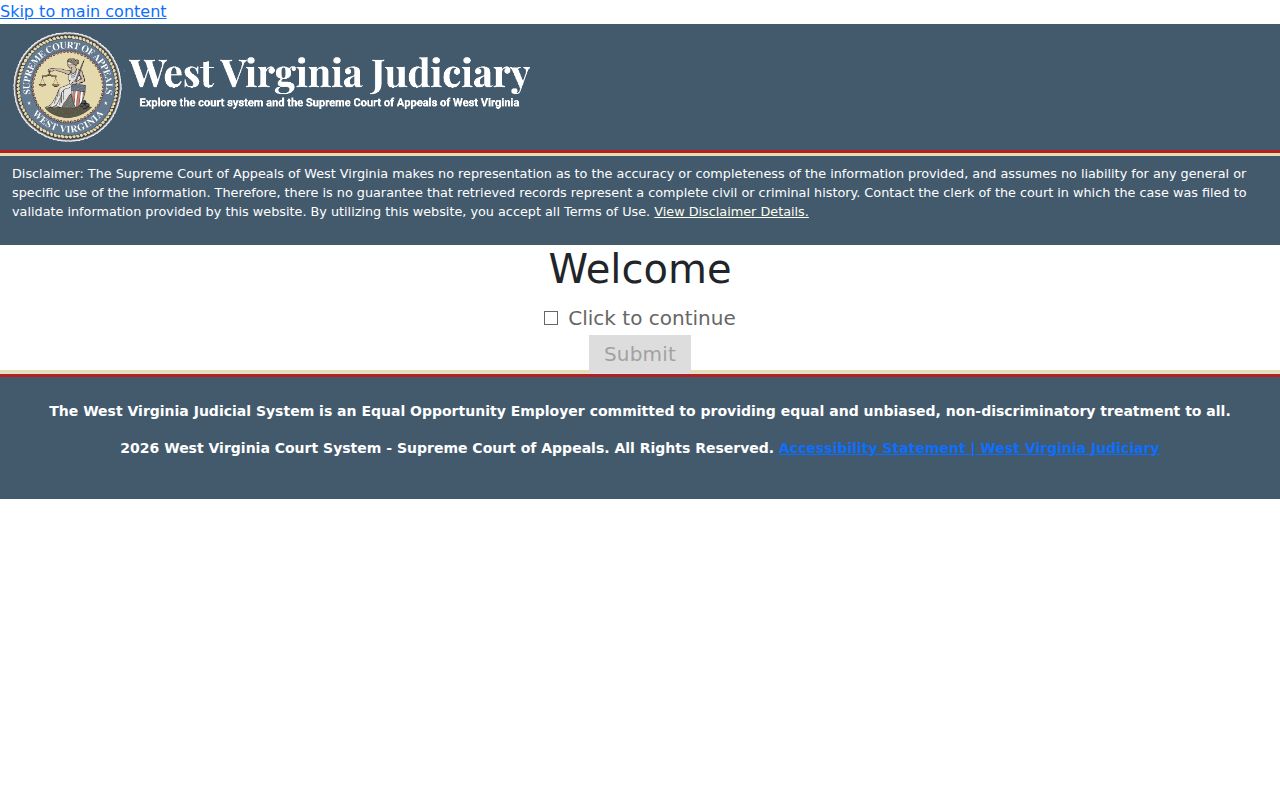
Think of this first screen as a gate. It opens the case search; it is not a docket result and not a document repository.
No online document button? That is expected in MCRSearch. Record the case number and ask the magistrate clerk for the specific complaint, order, or disposition.
Inside a Ritchie Criminal Docket
A criminal docket is the court's dated index of activity. Read it as a sequence. The filing date marks when the matter entered that court, not necessarily when the alleged conduct occurred. Party roles name the state and the defendant. A charge label records what was filed. Later entries may show amendment, dismissal, plea, transfer, or judgment. An event marked closed may describe that one event only. That does not mean the whole case was dismissed.
| Case number | The court's identifier; preserve every letter, number, and dash. |
|---|---|
| Charge | The alleged offense and, when shown, the statute or degree. |
| Events/settings | Dated arraignment, bond, pretrial, plea, trial, or review entries. |
| Plea | The plea recorded at a specific stage, which may later change. |
| Disposition | The recorded procedural or final outcome; obtain the order for exact terms. |
From Complaint to Ritchie Circuit
The Judiciary's magistrate search instructions explain both inputs. Name and case number are covered there, along with the 30-record display limit.
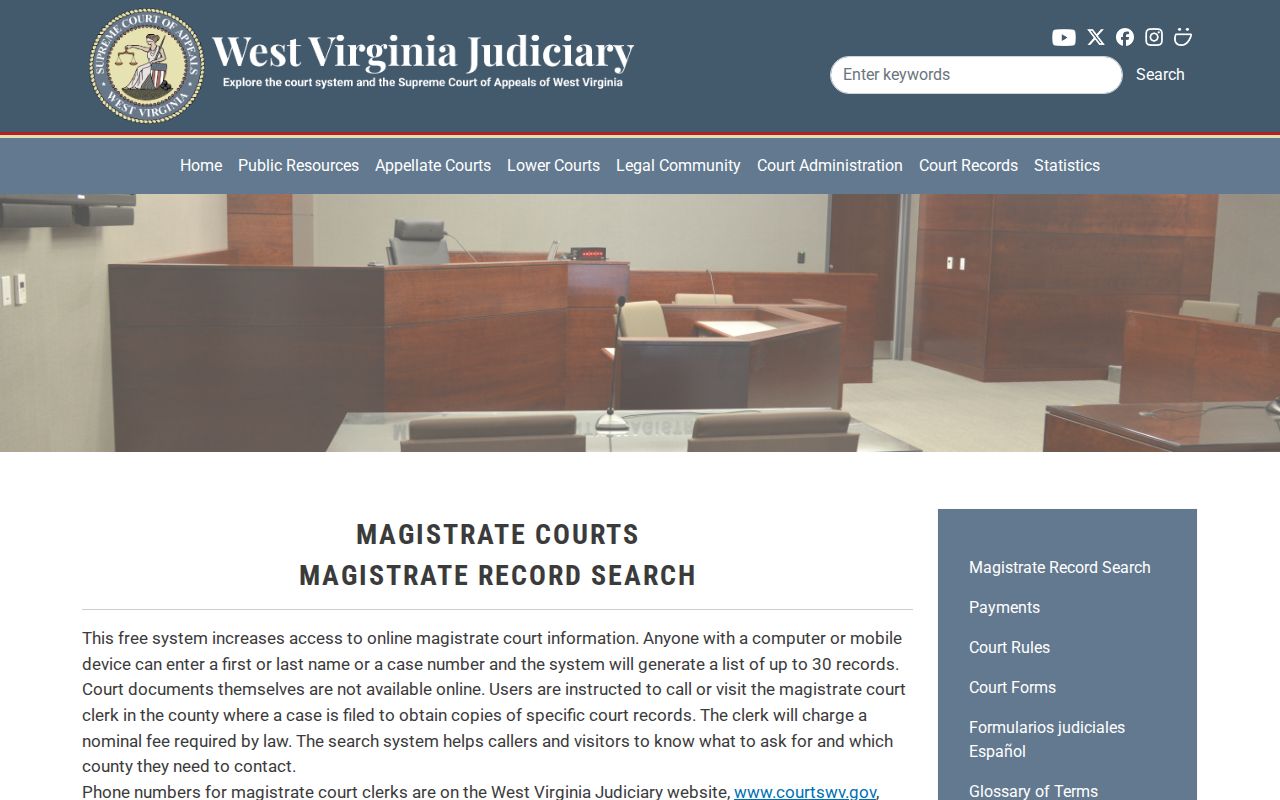
Those fields are a solid start. Use them before you follow a felony complaint into the circuit docket.
Magistrate Court handles misdemeanors and felony cases early on. A felony complaint can show up in MCRSearch with an initial appearance, bond activity, and a preliminary-hearing event. Later felony filings live in the circuit docket. Circuit courts are West Virginia's general-jurisdiction trial courts, and they also hear appeals from magistrate court.
This two-system trail breeds false no-results. Search the magistrate record first when all you have is an arrest, complaint, or initial citation. Then turn to WVPASS for the later circuit case. A case number can change after transfer. Match names, dates, charges, and court location instead of trusting one identifier through every stage.
How a Criminal Case Moves
Dockets open with a complaint or charging paper. Warrant or service information, an initial appearance, bond, and a rights acknowledgment tend to follow. Counsel, motions, pretrial settings, a plea, trial, sentencing, and disposition reporting can fill the later rows. Felony matters may add transfer and circuit filings. Each row records one action. Silence between rows proves nothing, since restricted, delayed, or document-only activity may never reach the public view.
Read the last order. A status label is only shorthand. A reset moves a setting, and a continuance delays one. A dismissal ends a charge or case only as its order states. A disposition can be procedural rather than a verdict. The Ritchie County Court Dates page covers the separate workflow for confirming a hearing.
Docket flow: Charge Filed › Arraignment › Pretrial Settings › Plea or Trial › Disposition
Ritchie Criminal Filing Numbers
The West Virginia Judiciary's 2025 annual report covers Ritchie County. It lists 53 felony filings and 873 misdemeanor filings. It also lists 5 worthless-check filings and 11 juvenile filings in the displayed magistrate criminal categories. These are filings, not people. They are not open cases, convictions, or findings of guilt. One person can generate several filings. Each filing can produce many docket entries.
Want a live count instead of a filing table? The Judiciary's statistics dashboard lets you filter Ritchie County criminal filings by judge and court type, and it refreshes daily around midnight. Write down the query date and the filters you chose, because an active-case total today answers a different question than an annual filing count.
Courts That Hold Criminal Dockets
Not every criminal docket sits in the same building. Ritchie Magistrate Court keeps lower-level files plus the earliest papers in many felony matters. MCRSearch covers those, and the magistrate clerk can hand over documents on request. Felony trials belong to the Circuit Court of West Virginia, Third Judicial Circuit. So do circuit misdemeanors, juvenile cases, and appeals. Its public entries appear in WVPASS. Official papers come from Circuit Clerk Melanie D. Wilson.
Municipal ordinance cases stay with the town that runs its own municipal court. There is no statewide municipal docket portal. Federal prosecutions are separate too: Ritchie County falls in the Clarksburg Division of the Northern District of West Virginia, where cases run through PACER instead of either state system. So sort out the charge and the court first. A missing state search never proves a record does not exist.
| Court | Typical criminal record | Public route |
|---|---|---|
| Ritchie Magistrate Court | Misdemeanors and felony beginnings | MCRSearch, then magistrate clerk |
| Third Judicial Circuit | Felonies and circuit proceedings | WVPASS, then circuit clerk |
| Municipal court | Local ordinance violations | Municipality or recorder |
| Federal District Court | Federal offenses | PACER and Clarksburg clerk |
Criminal Copies in Ritchie County
Finding the file online is only the first step. That screen is not a certified court record. For a magistrate document, give Lora Nutt's office the full case number, party name, document title, and an approximate date. Ordinary copies run 25 cents per page. Magistrate administrative rules set that rate, plus a $2 charge for the first faxed page and $1 for each page after it. Confirm the current cost and delivery options with the office before you send any money.
Circuit copies go through Melanie D. Wilson at 109 North Street, Suite 203, Harrisville, WV 26362, or by phone at 304-643-2164 extension 1 or 128. WVPASS allows registered public searching and may sell downloads. A clerk-certified copy is a different product. State law and Trial Court Rule 10.04 guarantee inspection and copying of public court records, within reasonable reproduction costs and confidentiality limits.
Ritchie Criminal Access Gateway
The Judiciary's public information page puts Ritchie County's circuit and magistrate criminal searches in statewide context.
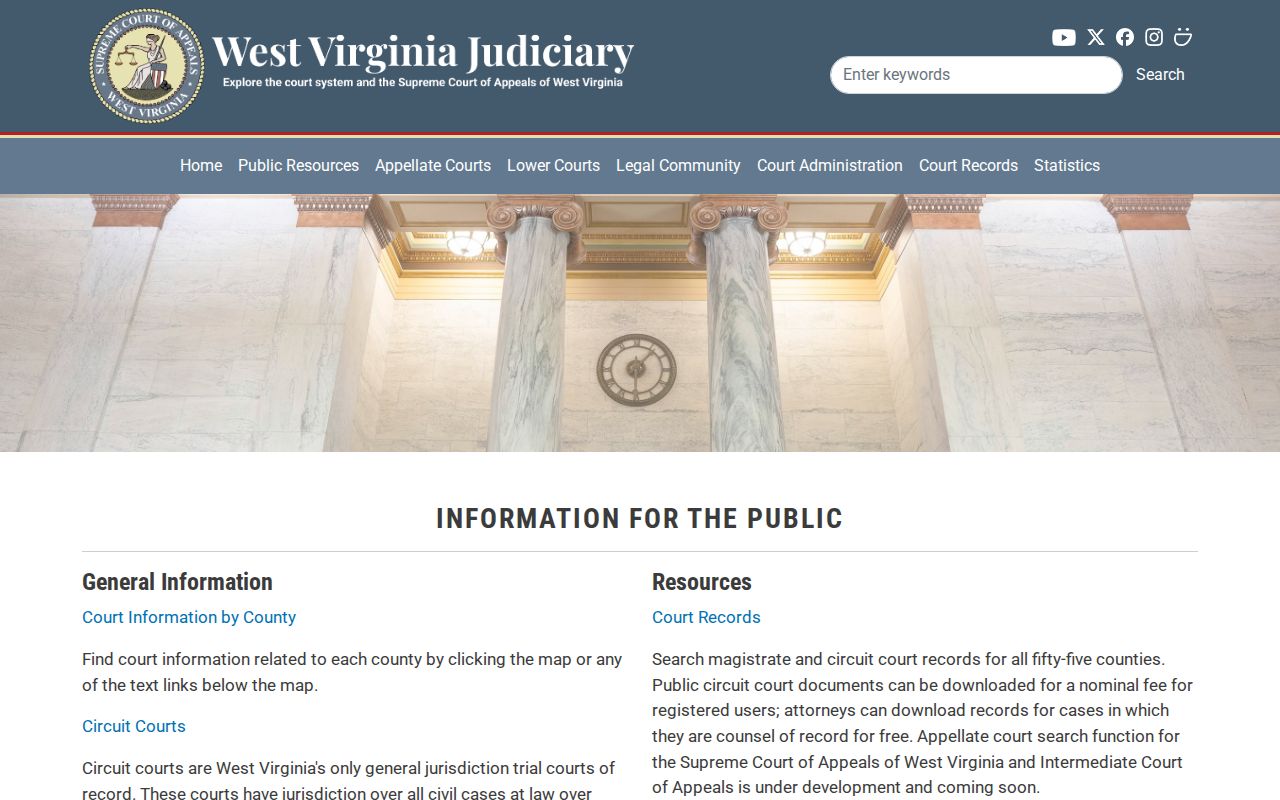
When a Ritchie County criminal docket entry makes no sense, or the paper behind it never went online, the route still ends at the clerk who filed it.
Sealed Dockets and Public Access
West Virginia opens most court records to the public. Criminal access, however, stops at firm lines. Juvenile files stay confidential unless a statute allows entry. A court may seal qualifying material. An expungement carries whatever public response the law requires. Victim details, sensitive identifiers, and word of an unserved warrant deserve to stay private. This applies even when a neighboring entry is public. Remember that a portal's no-result screen cannot tell you why a case is missing.
If access is denied, ask the clerk about the record. It may be sealed, confidential, archived, held elsewhere, or outside that office entirely. Name the exact docket entry or document you want. Narrow requests move faster and steer clear of protected material. West Virginia's Freedom of Information Act governs records held by public bodies. Court case records, though, also answer to court-specific statutes and rules.
Key Rules:
West Virginia Code § 51-4-2 authorizes inspection and copying of court records, subject to lawful limits.
West Virginia Code § 49-5-103 protects juvenile records and defines limited exceptions.
West Virginia Code § 61-11-26 governs qualifying criminal expungements and the public response after sealing.