
How to Search Cases by Name
Two state tools do most of the work here. The Magistrate Case Record Search instructions explain the free search by name or case number. MCRSearch holds public magistrate information and returns no more than 30 records at a time. For circuit cases, WVPASS is the registered public search. Type the full legal name first. Then check Ritchie County, the case location, the filing date, and the case type before you call a result a match.
Spelling drives everything. Initials, suffixes, and party roles can shift what a query returns. Narrow the form if a common surname hits the 30-record limit. In a civil matter, search both parties. A blank result may simply mean the wrong court, a municipal record, an archive, a transfer, or a restricted case.
- Open the state court-record gateway and select magistrate or circuit.
- Enter the case number, or use the most complete party name available.
- Confirm Ritchie County, court, type, and filing date.
- Open the detail, read the latest event, and save the case number for the clerk.
| Field Label | Type | Required | Notes |
|---|---|---|---|
| Last name | Text | For name search | Use the legal spelling; broad results can hit the display cap. |
| First name | Text | Useful | Narrows common surnames. |
| Case number | Text | Alternative | Enter every character and dash exactly. |
| Case location | Result field | Verify | Confirm Ritchie County and the correct court. |
Why Ritchie Searches Split
West Virginia keeps magistrate and circuit data on separate public routes. MCRSearch covers magistrate cases but hands out no document copies online. WVPASS covers circuit records and asks you to register. CourtPLUS/E-File is the registered filing and service system, not a substitute search box. Ritchie went live on CourtPLUS on April 26, 2021. WVPASS public access began statewide on March 10, 2025.
Municipal ordinance records sit somewhere else entirely. Pennsboro posts a municipal-court code chapter and an official listing of its municipal judge. Yet the city offers no public search application. Harrisville, Ellenboro, Cairo, and Pullman have no public municipal portal either. For a precise ordinance-record request, contact the town or its recorder.
The Judiciary's official court-record gateway lays out that split before any search begins.
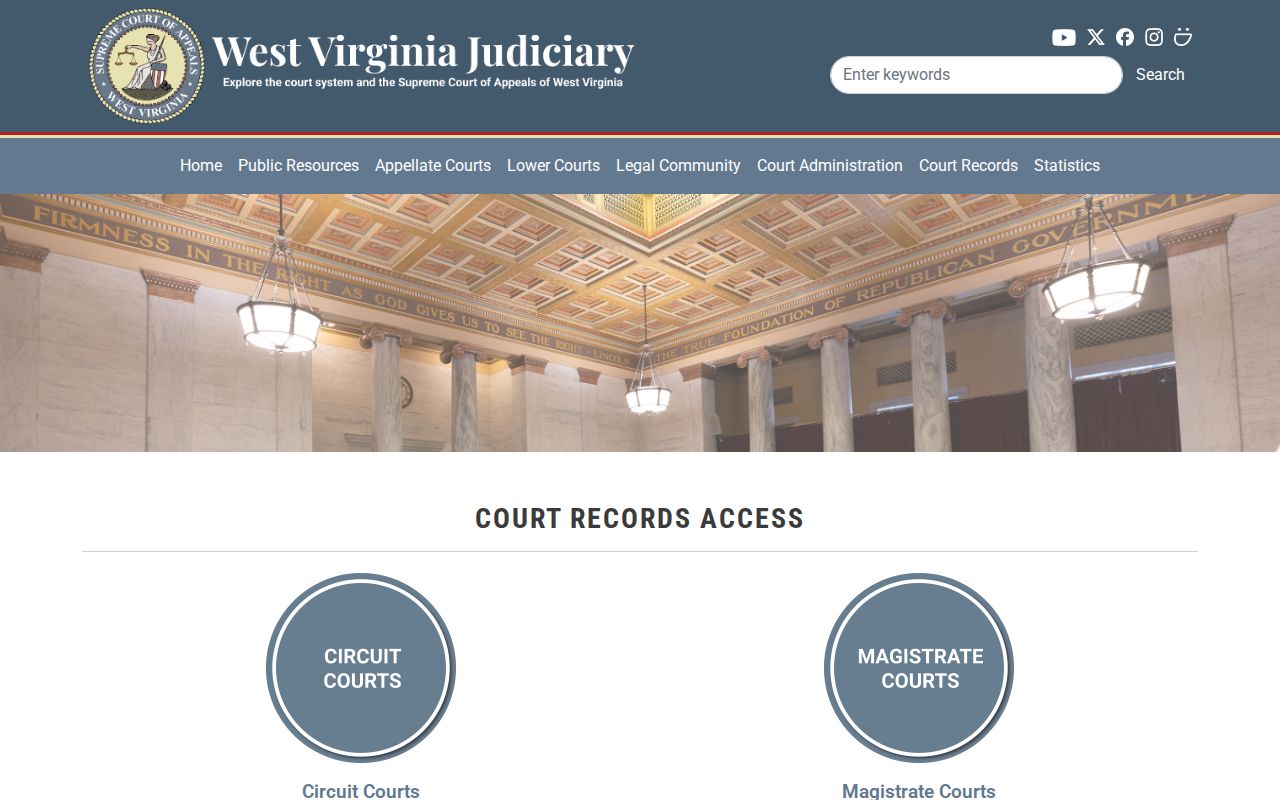
Pick the court first. Otherwise a missing result in one system can look like proof that no Ritchie County case exists, when the file simply lives somewhere else.
How to Search by Case Number
A case number is the safest key for a Ritchie County docket search. It points to one file in one court. Copy it exactly as it appears on a notice, an order, or a portal result. Do not invent a local format; the public systems display the controlling number. Keep the letters, leading zeros, spaces, and dashes intact. A transferred felony or an appealed civil case may carry a different number in the next court up.
When a number fails, check what you actually hold. It might be a citation ID. It might be a payment-plan ID, a document number, or a federal number. The magistrate payment system accepts exact Citation ID, Case ID, or Payment Plan ID values. It also warns that the entry must match. Federal cases run through PACER and never appear in WVPASS.
MCRSearch Stops at 30
MCRSearch stops at 30 records, period. The cap makes any broad name query incomplete by design. Add a first name, verify the spelling, or switch to the case number. The tool also says plainly that it is not a criminal-history report. It points users to the clerk for official information.
Too many matches? Narrow the name and compare case location, type, and filing date. If the likely match is still outside the display, call Ritchie Magistrate Clerk Lora Nutt at 304-643-4409.
A capped result is not a person's whole story. Never infer that someone has only the cases shown. Never assume two similar names mean the same person. The point of the lookup is to find a known court matter or public filing, not to build a profile of someone.
The official magistrate search page lays out the name and case-number choices before a Ritchie County lookup.
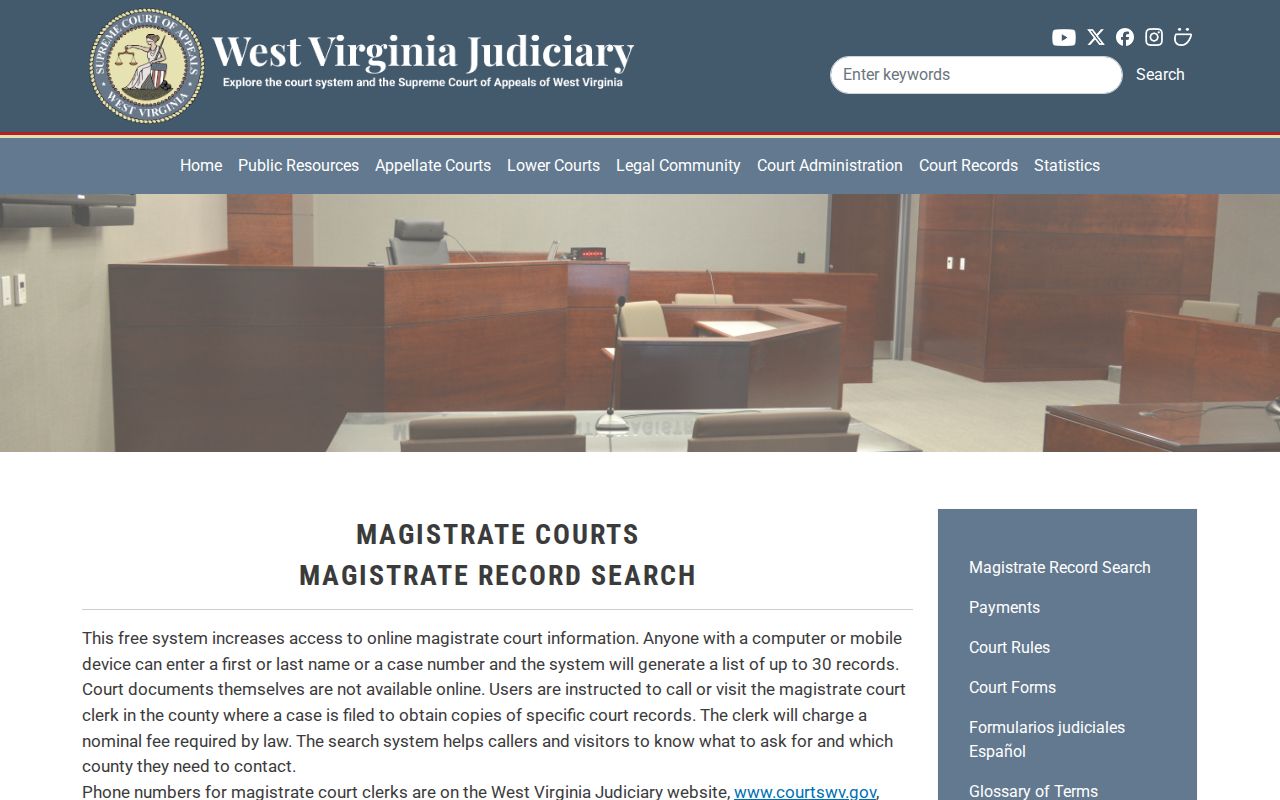
The limited field set rewards precise spelling and an exact court case number.
What a Case Search Shows
A single result can carry a lot: case location, case number, filing date, party roles, type, status, events or settings, docket entries, disposition, and a document list. Read those fields together. "Closed" may describe one event, not the file. "Disposition" can be procedural rather than final. A listed document is not always one the public can download. For exact terms, the clerk-held order still governs.
| Case number | The court's exact identifier. |
|---|---|
| Style/parties | Names and roles in the case caption. |
| Case type | The category assigned by the filing court. |
| Filed date | When the case entered that court, not necessarily the event date. |
| Status | Portal shorthand that should be checked against the newest order. |
When Ritchie Results Look Wrong
Verify the court first. A state-law ticket usually runs through magistrate. A city ordinance matter may stay with the municipality. A felony can climb from magistrate to circuit. Family records can be partly confidential. Deeds, probate, wills, liens, and vital records belong to the Ritchie County Clerk, not to either case portal.
Then verify time and custody. Older paper files may sit in the Vault after scanning. They may also have moved to an archive. A case can be sealed, expunged, transferred, or held under a schedule that limits public display. Ask the clerk whether an index or archived file exists, and give a date range. Never send Social Security numbers, birth dates, account numbers, victim data, or juvenile identifiers.
An official MCRSearch case-detail view sorts each result into parties, summary, events, and docket entries.
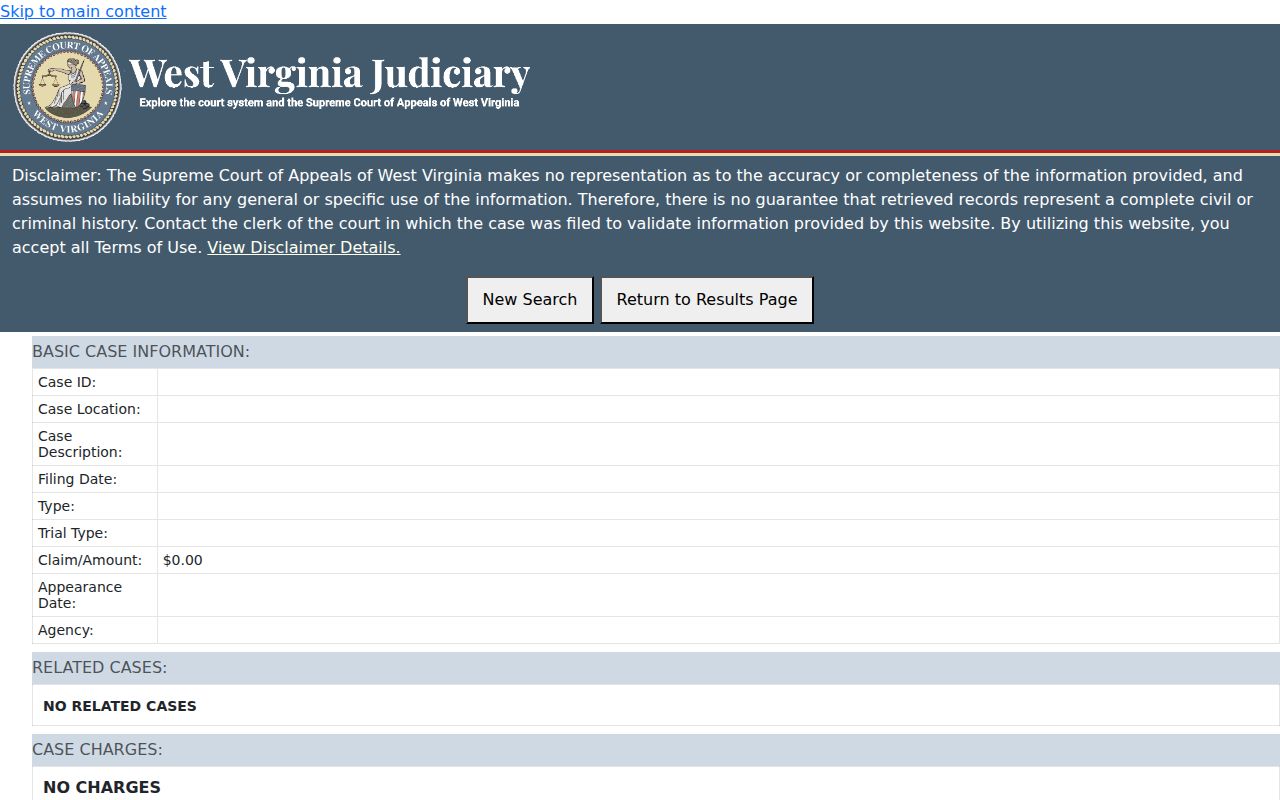
Those blocks help you trace a known Ritchie County matter. The clerk still controls copies, though, and only that office can confirm what an entry truly means.
County vs Statewide Case Search
Ritchie County runs no local trial-case portal of its own. Public state case information flows through MCRSearch and WVPASS, while the local clerks validate entries and hand out documents. The Ritchie County Clerk website is a genuine local records source, but its land and probate scope is not a court docket database, so do not mistake it for one.
| Statewide Portal | Ritchie County Portal |
|---|---|
| MCRSearch or WVPASS across West Virginia court data | Ritchie clerk for the local file and copy |
| Public index, events, and permitted documents | Clerk-held pleadings, orders, and certification |
| Best for locating a public case | Best for confirming custody and obtaining proof |
Three Ritchie Clerk Routes
Three clerks, three doors. Circuit Clerk Melanie D. Wilson keeps circuit and family case files at 109 North Street, Suite 203, in Harrisville. Her office answers 304-643-2164 extension 1 or 128. Magistrate cases go elsewhere. Magistrate Clerk Lora Nutt, in Suite 102 at 304-643-4409, handles magistrate criminal, traffic, civil, and personal-safety files. The County Clerk, at 115 E. Main Street, Room 201, extension 106, is your stop for land, probate, will, lien, vital, and county records. So match the clerk to the docket before you dial.
Whatever you request, be precise. Give the court, the county, the case number, a party name, the document, and the date. Ask if the copy can travel by email or must be picked up, whether a fee applies, and whether you need it certified. One quirk: the same address sometimes appears as North Street and sometimes as East North Street. Confirm by phone and keep the suite number handy.
Ritchie Case Request Checklist
A good request saves everyone time. Rule 10.04 lets you inspect and copy court records at reasonable length during usual business hours. Electronic access works when the record exists in that form. The clerk may watch over your inspection and charge the lawful reproduction cost.
Make your Ritchie County case lookup narrow. Staff can then pull an existing record rather than build a new report. Include the county, the court tier, the case or citation number, the rough filing date, a party name for identification, and the exact document you want. Say whether you seek inspection, a plain copy, or a certified copy. Mailing a request? Ask first about the total cost, accepted payment, postage, and how it comes back. Ritchie County posts no web copy-request form. A phone call is the practical first move before you send money or private details.
Note: A clerk can retrieve an existing record but need not create a custom case-history compilation.
Restricted Cases and Access Rules
West Virginia opens its court records to inspection and copying through Code § 51-4-2 and Trial Court Rule 10.04. Not everything is public. Juvenile files stay confidential under section 49-5-103. Family court pleadings and recordings can be sealed even when the orders and indexes sit in plain view. Sealed cases, expunged cases, domestic-violence matters, and records packed with personal identifiers all get extra protection.
So a docket search may skip the case entirely. It may blank out some fields, or show only a thin index. Call the clerk to learn the lawful access path and name the exact record you need. No request, however polite, overrides a seal or a confidentiality rule. If the clerk says no, ask what authority blocks you. Ask whether a redacted public version exists, and whether some review process is available.
Safe search practice: use names and case numbers needed to locate the file, but never republish private identifiers, victim information, juvenile data, or details of an unserved warrant.